Disclosure: This article contains Amazon affiliate links, marked as paid links. As an Amazon Associate I earn from qualifying purchases. From Fog to Facts is my own published workbook.
There are approximately a million things people will tell you after you've been cheated on.
"Everything happens for a reason."
"You just have to forgive."
"Stop living in the past."
Oh, fantastic. Thank you. I'll just switch off the part of my brain that's trying to figure out which pieces of my life were real.
Why didn't I think of that?
Here's what people don't always understand about infidelity: It's not necessarily just the sexual betrayal that causes the damage.
It's the secrecy. The decisions. The things you weren't allowed to know while someone else was making choices that affected your life.
It's realizing two people may have been participating in entirely different versions of the same relationship.
And then there are the questions.
How did it start? Why did it continue? What was real? Can trust actually be rebuilt? And how are you supposed to make a decision about your future when you aren't even sure you have the whole story?
There's no single book that can answer all those questions.
But there are books that offer useful perspectives on emotional affairs, relationship betrayal, accountability, and recovery.
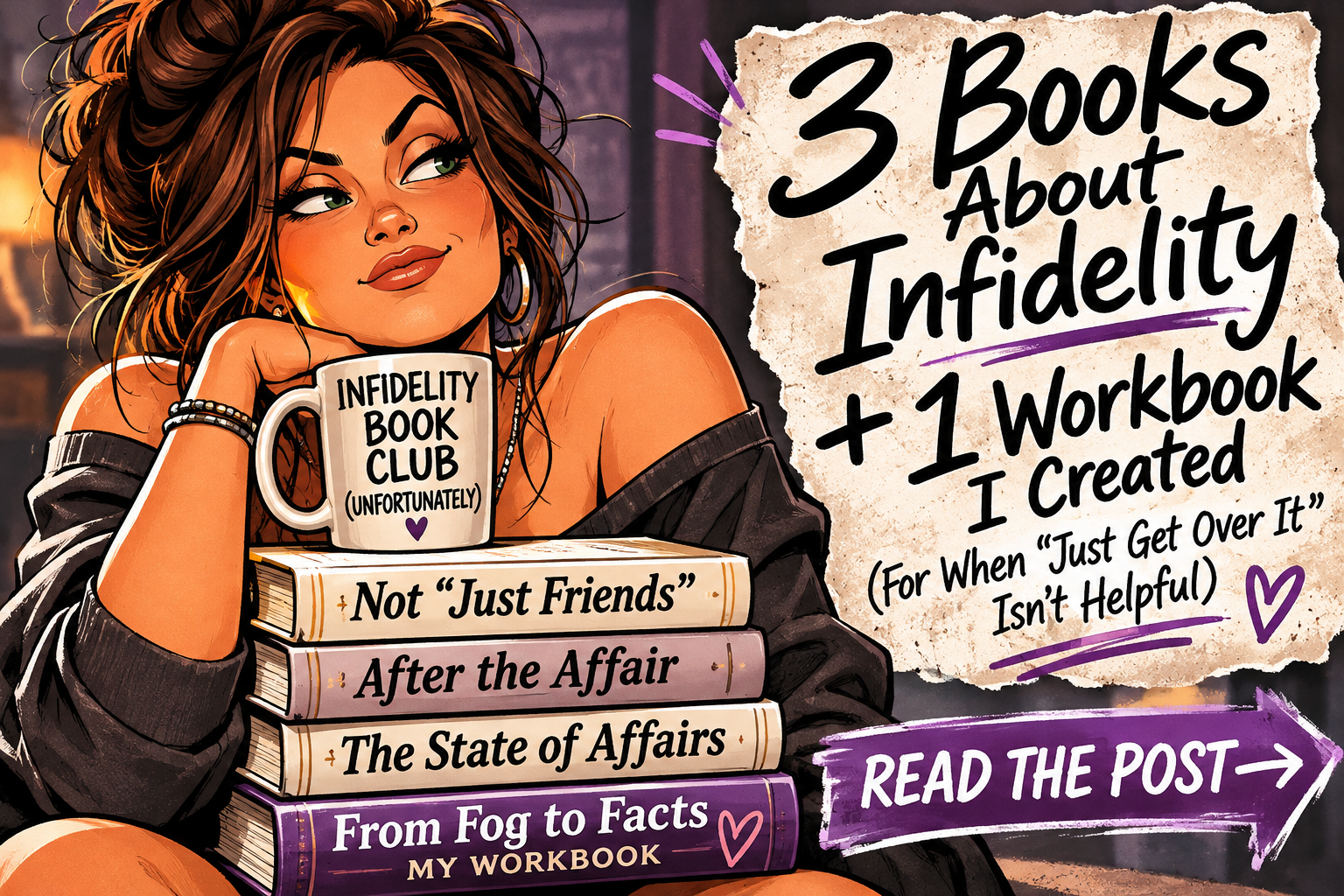
Here are three worth knowing about, along with a guided workbook I created for people trying to find clarity in the aftermath.
1. Not "Just Friends" — Shirley P. Glass, PhD
Best for understanding emotional affairs, secrecy, crossed boundaries, and how infidelity develops.
"We're just friends."
How many relationships have been thrown into chaos by those three little words?
To be clear, people in committed relationships are allowed to have friends. That's not the issue.
The issue is what happens when friendship becomes secrecy. When emotional intimacy starts shifting outside the relationship. When boundaries are crossed and then explained away as harmless.
In Not "Just Friends", psychologist Shirley P. Glass examines how emotional and physical affairs develop, particularly through friendships that gradually become something more.
The book explores the progression of inappropriate intimacy, the role of secrecy, and how people rationalize behaviors they might once have considered unacceptable.
Why it's worth considering
One of the most important questions following betrayal isn't simply, "What happened?"
It's, "What decisions made it possible?"
Because an affair isn't always one dramatic moment when somebody suddenly loses their mind and forgets they're in a relationship.
Sometimes it's a progression of smaller decisions.
One conversation becomes another. A boundary gets pushed. Something gets hidden. Someone decides it's easier to justify their behavior than acknowledge what they're doing.
Glass provides a framework for understanding that progression.
Who might benefit: Readers trying to understand emotional affairs, workplace relationships, blurred boundaries, or the shift from friendship into betrayal.
Explore Not "Just Friends" on Amazon (paid link)
2. After the Affair — Janis Abrahms Spring, PhD
Best for understanding the aftermath of infidelity and the difficult work of rebuilding trust.
Finding out about an affair is devastating.
But there's something people don't talk about enough.
Sometimes discovering the betrayal isn't the most complicated part.
It's everything that happens afterward.
It's trying to have an ordinary Tuesday when your brain has approximately 47 unanswered questions.
It's wondering whether a loving moment is genuine or whether you're just desperate for things to feel normal again.
It's listening to someone say they're sorry and realizing that, as much as you might want the apology to fix things, you still have no idea how you're supposed to feel safe.
After the Affair addresses the emotional fallout of infidelity and explores how couples can approach the process of rebuilding trust.
Janis Abrahms Spring examines the experiences of both partners, including anger, grief, guilt, forgiveness, responsibility, and the challenges of moving forward.
Why it's worth considering
The book distinguishes between wanting to repair a relationship and actually participating in that repair.
Those aren't the same thing.
A couple can desperately want to stay together while still struggling to communicate honestly, tolerate difficult conversations, or understand what rebuilding trust requires.
And while the betrayed partner may need reassurance and transparency, the unfaithful partner may have significant work to do around accountability and understanding the harm caused.
Who might benefit: Couples considering reconciliation, betrayed partners trying to understand their emotional responses, and unfaithful partners who want to understand the responsibilities involved in repair.
Explore After the Affair on Amazon (paid link)
3. The State of Affairs — Esther Perel
Best for exploring the psychology of infidelity, desire, and why people risk relationships they claim to value.
Here's an uncomfortable question:
Why do people cheat on someone they say they love?
People have plenty of theories.
They were unhappy. They wanted attention. They were bored. Their relationship was missing something.
And sometimes those explanations may be part of the story.
But human behavior is rarely that tidy.
In The State of Affairs, psychotherapist Esther Perel examines infidelity through the lenses of relationships, identity, desire, attachment, and the expectations we place on long-term commitment.
Rather than presenting one universal explanation for cheating, she explores the contradictions that make infidelity such a difficult subject.
Why it's worth considering
This book asks readers to examine uncomfortable possibilities.
That doesn't mean everyone will agree with Perel's conclusions.
In fact, readers who have experienced betrayal may find some of her perspectives challenging.
But examining why people make destructive decisions can be valuable, provided we maintain an important distinction:
Understanding someone's behavior does not automatically excuse it.
There is a significant difference between explaining why someone felt drawn toward an affair and suggesting those feelings justified betraying their partner.
Feeling something doesn't eliminate responsibility for what you decide to do about it.
Who might benefit: Readers interested in the psychological and relational complexities of infidelity, including questions that don't have simple answers.
Explore The State of Affairs on Amazon (paid link)
Which Infidelity Book Should You Start With?
The best place to begin depends on what you're trying to understand.
| Your biggest question | Book to explore |
|---|---|
| How did a friendship turn into an affair? | Not "Just Friends" |
| What does repairing a relationship actually involve? | After the Affair |
| Why do people cheat, even in relationships they value? | The State of Affairs |
| How can I begin sorting through my own confusion and rebuilding self-trust? | From Fog to Facts |
These resources approach betrayal from different directions. None can guarantee a particular outcome, and none can provide the missing truth about someone else's choices.
But understanding the questions you're facing is a meaningful place to begin.
4. From Fog to Facts — A Betrayal Recovery Workbook by K.M. Warren
Best for finding clarity, rebuilding self-trust, and navigating what comes next after betrayal.
Reading about betrayal is one thing.
Living through it is another.
You can understand everything a psychologist says about emotional affairs and still find yourself lying awake at night trying to make sense of your own relationship.
You can read about accountability and still struggle to figure out whether the person sitting across from you is actually taking responsibility.
You can learn the language of betrayal recovery and still feel completely lost when it comes to your own next step.
That's one reason I created From Fog to Facts.
It's my own betrayal recovery workbook, written for people navigating the uncertainty that follows broken trust.
Because sometimes the most exhausting part of betrayal isn't just what another person did.
It's what the experience does to your confidence in your own perception.
You question your memories.
You question your instincts.
You wonder whether you missed something obvious or whether you were deliberately given a version of reality that made the truth impossible to see.
And somewhere in all that confusion, you may start questioning yourself more than you question the person who betrayed you.
Why I created it
I believe people experiencing betrayal deserve space to examine what they know, what remains uncertain, what they need, and what choices are available to them.
Not everyone wants to end their relationship.
Not everyone wants to reconcile.
Some people don't know what they want yet because they're still trying to understand what happened.
And that's a valid place to begin.
From Fog to Facts: A Betrayal Recovery Workbook for Finding Clarity, Rebuilding Self-Trust, and Navigating What Comes Next was created with that uncertainty in mind.
It isn't a promise that your relationship will survive.
It isn't a demand that you forgive someone.
And it isn't a substitute for honesty, accountability, or professional support.
It's a resource centered on something betrayal can seriously undermine: your ability to feel grounded in your own understanding and decisions.
Explore From Fog to Facts by K.M. Warren on Amazon
This is my own published workbook, not an independent third-party recommendation.
The Part No Book Can Do for You
There's something worth remembering before you spend another sleepless night researching why people cheat.
You can read every book on infidelity ever written.
You can understand attachment, emotional affairs, rationalization, guilt, shame, forgiveness, and the psychology of betrayal.
You can become exceptionally good at recognizing unhealthy patterns.
And still not know exactly what happened in your own relationship.
Because understanding infidelity in general is not the same thing as knowing the truth about your particular experience.
No book can make someone tell you something they're unwilling to disclose.
No workbook can manufacture accountability.
And no amount of personal growth can single-handedly repair a relationship that requires two people to participate.
But resources can help you ask better questions, understand your reactions, recognize your needs, and make more informed choices.
And maybe the most important thing to remember is this:
You don't need to have your entire future figured out today.
You don't have to decide whether to stay, leave, forgive, or begin again before you've had a chance to understand what you're living through.
You can want to repair your relationship and still need answers.
You can love someone and still require accountability.
You can be uncertain about your next step without surrendering your right to make it.
And you can work toward understanding someone else's choices without losing trust in your own judgment.
— Static & Smoke
These resources are educational and reflective, not substitutes for individualized mental health care or couples counseling.